- Best Ever CRE
- Posts
- 🤖 How an AI agent just signed a 3-year lease
🤖 How an AI agent just signed a 3-year lease
Plus: BTR survives, security gets breached, construction costs spike, and much more.

Best Ever CRE Team
May 17, 2026

Together With

👋 Happy Sunday, Best Ever readers!
In today’s newsletter, AI elevates retail, BTR survives, security gets breached, construction costs spike, and much more.
Today’s edition is presented by Equity Institutional Services. Your investors have IRA capital — most sponsors just don't know how to access it without slowing down their raise. Equity Institutional Services gives you the custody infrastructure, dedicated support, and sponsor-friendly tools to make self-directed IRA participation a standard part of every offering. Download the free Capital Raise Guide.
💰 Free Webinar | Depreciation Mistakes Costing You Thousands. If depreciation strategy isn't part of your underwriting process, you're probably leaving money behind on every deal. Thursday, May 21, at 1 pm ET, we're showing you exactly where — and how to fix it. Register free.
Let’s CRE!
🗞️ NO-FLUFF NEWS
CRE HEADLINES
🏘️ BTR Survives: A forced-sale provision that would have required build-to-rent operators to divest properties after seven years has been stripped from the 21st Century Road to Housing Act, with a House floor vote expected next week.
🔓 Data Breach: Cushman & Wakefield is facing a proposed class action after hacker group ShinyHunters claimed access to more than 500,000 sales-team records and threatened to release the data unless a ransom was paid. The brokerage has called the lawsuit baseless.
🏭 Industrial Rebound: U.S. industrial leasing totaled 226.7M SF in Q1 2026, the strongest first quarter since 2022 and up 20.8% YoY, according to Savills. Completions fell sharply — from 98.1M SF in Q1 2025 to 63M SF this year.
🏢 Rent Divide: Sun Belt rents have fallen 2.1% YoY in TX and 1.6% in FL, respectively, as supply outpaces demand, while San Francisco one-bedroom rents have climbed 8.2% to $3,351 monthly on AI-sector hiring. Fort Myers leads the nation in concessions at 5.3%.
🔨 Fit-Out Costs: Office fit-out costs have reached a national average of $295 PSF for medium-quality corporate space, with high-spec traditional buildouts hitting $425, according to JLL. Technology infrastructure now represents up to 12% of total fit-out cost.
🏆 TOP STORY
PHYSICAL RETAIL'S SECOND ACT IS ALREADY UNDERWAY

The dominant narrative around physical retail has been wrong for years. While e-commerce anxiety kept investors on the sidelines, retailers quietly expanded — and now AI is accelerating that growth in ways that are starting to show up in the real estate itself.
In April, a San Francisco research firm handed full operational control of a retail store to an AI agent named Luna. She autonomously signed a three-year lease, hired staff, selected inventory, and ran daily operations without human input. It's an extreme example — but it signals where the technology is heading, and what landlords may soon need to account for.
Today, 85.1% of U.S. retail sales still flow through physical stores, and 71% of retailers are growing their footprints in 2026, according to Colliers. The sector isn't retreating from the AI era. It's being redefined by it.
The shift changes what retail real estate is worth, and how to underwrite it. The traditional occupancy cost ratio — gross rent as a percentage of in-store sales — was built for a world where the store's only job was to close a transaction. That world is gone.
Stores now serve as fulfillment hubs, customer acquisition engines, and data generation assets. Four-wall sales alone no longer capture what a high-performing location actually produces.
Stores Are the E-Commerce Backbone: One in four online orders is now fulfilled through a physical store, a share that has nearly doubled since 2021 and is projected to reach 35% by 2030. Buy Online, Pick Up In Store (BOPIS) alone accounts for 8.9% of total retail revenue, up 71% YoY. Only 18% of retailers have fully optimized the process, meaning the margin opportunity remains largely unrealized.
Technology Investment Is the New Dividing Line: Retail leaders grew IT spending 52% over the past five years versus 13% for slower-moving peers, and are on track for nearly three times higher profit growth in 2026. Retailers deploying 5G at the store level are seeing 71% higher profit growth compared to non-5G peers.
The Tenant Mix Is Shifting: AI deployment varies sharply by business model. Walmart runs digital twins across 1,700-plus stores. Dollar Tree is in the middle of the largest tech investment in its history. What each tenant requires from their physical space over the next five years differs vastly — and landlords underwriting those tenants need to account for it.
Forward-looking landlords are moving to total location productivity, a framework that captures store-fulfilled digital sales, BOPIS volume, and retail media revenue alongside traditional four-wall sales.
Technology can no longer be layered onto a finished property. Fulfillment-grade power, 5G, and AI-ready data architecture have to be built in from the start. Properties designed for this model and those that weren't are already diverging in value.
THE BOTTOM LINE
Retail CRE is expanding, but the assets capturing that growth aren't built according to last decade's specs. Landlords underwriting to four-wall sales metrics are working from an incomplete picture. The operators moving to total location productivity frameworks now are the ones positioned to set lease terms rather than accept them.
🤝 TOGETHER WITH EQUITY INSTITUTIONAL SERVICES
UNLOCK A HIDDEN SOURCE OF CAPITAL

Many capital raisers overlook one of the largest pools of investable assets: IRAs. With trillions available*, more investors are actively looking for opportunities like yours.
At Equity Trust, we make it easy to get investors set up, funded, and into your raise quickly and without unnecessary friction.
From day one, you’ll have a clear, transparent process and a responsive team by your side. No guesswork. No delays. Just straightforward support and consistent communication every step of the way.
Raise capital more efficiently and get back to focusing on your next opportunity.
💰 CRE TRENDS
HARD CONSTRUCTION COSTS HIT A THREE-YEAR HIGH
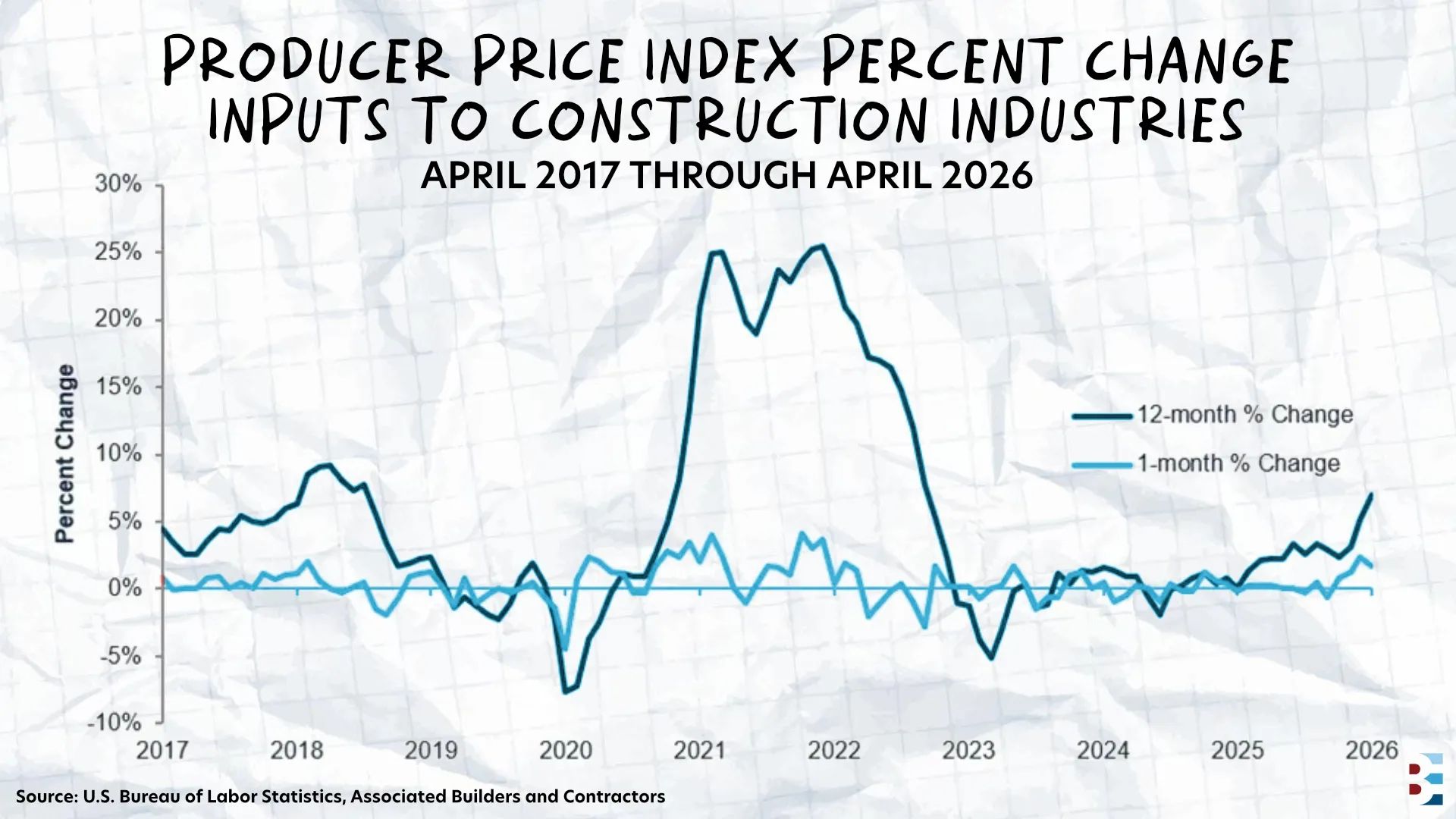
Construction input prices have risen more in the first four months of 2026 than they did in the prior three years combined, a pace that's landing on developers already navigating elevated borrowing costs and tighter lending conditions.
Energy drove the sharpest gains. Crude petroleum prices jumped 11.3% between March and April alone, and are up 61.8% YoY. Natural gas climbed 27.3% over the same period. Those increases ripple across every phase of construction through fuel, transportation, and equipment costs. Core materials followed.
Lumber: Softwood prices rose 5.5% MoM, adding pressure to multifamily and wood-frame projects already stretched on margins.
Steel: Hot rolled steel bars climbed 4.1% MoM, with steel mill products up 3.8% — a direct hit to industrial and large-format construction budgets.
Broad Pressure: Overall construction materials are 7% higher YoY, while nonresidential input costs are up 7.4% annually.
The Fed complication is real. Wholesale inflation came in at 1.4% in April — nearly triple economists' expectations — making near-term rate cuts less certain. For CRE developers, that's a difficult equation: financing costs stay elevated while hard costs keep climbing.
▶️ BEST EVER WEBINARS
DEPRECIATION MISTAKES COSTING YOU THOUSANDS

The deals are good. The returns look solid. But if depreciation strategy isn't built into your underwriting from day one, you're likely leaving significant after-tax value behind on every acquisition.
On May 21 at 1 pm ET, Lon O'Connor and Ed Vettle break it down with real-world examples across multifamily, office, industrial, and manufacturing properties. Free to attend.
🎙️ THE BEST EVER CRE SHOW
HOW TO TRAIN AI TO UNDERWRITE DEALS LIKE YOU

The operators getting the most out of AI aren't using better tools. They're giving those tools better information.
Jake Heller has spent years building what he calls a digital brain — a Claude skill built around a 15-page acquisition criteria document covering everything from renovation tier costs to LA's mansion tax implications to rent control nuances. It underwrites deals exactly the way he does, because he trained it to.
This week on the Best Ever CRE Show, Heller — a third-generation real estate operator and co-founder of the AI for CRE Collective — joined Matt Faircloth to explain how CRE operators can build AI infrastructure that actually reflects the way they think.
The foundation, he says, is prompt construction. Heller uses a framework called RTCF — Role, Task, Context, Format — to structure every AI interaction.
Role: Assign the AI a specific identity before asking it anything. Telling Claude it's a Blackstone managing director who has underwritten apartments in Pennsylvania for 40 years produces a fundamentally different output than an open-ended prompt.
Task: Be specific about what you want. "Analyze this deal" is a bad prompt. "Build a five-year pro forma using the following assumptions" is a good one.
Context: This is where most operators fall short. Without your actual underwriting assumptions baked in, the model will source its own — and those may be wrong. Heller's example: if you underwrite rent growth at 3% in Pennsylvania and don't specify that, the model may pull an outlier figure from a social media post and run with it.
The goal is a system that's model-agnostic — a knowledge base so complete that if Claude goes down, you can point any model at it and pick up exactly where you left off.
"Garbage in, garbage out," says Heller. "It takes a huge time investment to get AI to a point where it's delivering usable outputs."
🎙️ For more on how Heller built his “digital brain,” listen to the full episode here.
🙏 Thanks for reading!
Stay in the loop with us! If you received this newsletter from someone else, subscribe here. You can also find us on LinkedIn, Instagram, and YouTube.
Have a Best Ever day!
— Joe Fairless