- Best Ever CRE
- Posts
- ⛳ How Augusta National built a $500M real estate empire
⛳ How Augusta National built a $500M real estate empire
Plus: The war redirects capital, tariffs get restructured, office at a discount, and much more.

Best Ever CRE Team
April 09, 2026

Together With

👋 Hello, Best Ever readers!
In today’s newsletter, Augusta National’s real estate empire, the war redirects capital, tariffs get restructured, office at a discount, and much more.
Today’s edition is presented by M1 Real Capital. Built through $3B+ in transactions and trusted by more than 1,000 operators, fund managers, and capital allocators. M1 installs the systems used to create predictable private capital. Book a Capital Constraints Call to diagnose exactly where your raise breaks and how to fix it.
🗝️ Introducing the Best Ever Inner Circle, a private group of active operators — fund managers, syndicators, and GPs — who are solving the problems you can't Google. Capital raising. Live deals. Lender pressure. Scaling. Q2 applications are open now. See what the room is working on and apply below.
Let’s CRE!
🗞️ NO-FLUFF NEWS
CRE HEADLINES
🌍 Capital Shift: Foreign capital that had been flowing into Gulf real estate at a growing rate has begun shifting toward U.S. markets following strikes on Iran, as Walton Global launches a new Shariah-compliant U.S. land fund targeting Asian and Middle Eastern investors.
⚙️ Tariff Tiers: The U.S. has restructured steel and aluminum tariffs into a tiered system with 50% and 25% rates calculated on total import value rather than metal content, a shift that broadens the taxable base and raises construction cost exposure for CRE developers.
🏘️ Rental Tailwinds: A 44% cost gap between renting and homeownership, mortgage rates above 6%, and multifamily starts down 60% from peak have combined to sustain rental demand even as new supply cools toward pre-2016 delivery levels.
🛍️ Retail Leverage: Retail landlords have pushed median lease-up time to a historic low of under seven months, with vacancy holding at 4.3% nationally, as owners add customer acquisition cost recovery clauses and sales-volume requirements to guard against future tenant failures.
🏗️ LP Crunch: Core capital funds have largely exited multifamily development, forcing sponsors to compete for a narrow band of opportunistic and foreign LP commitments, with investors backing only two or three of 30 to 40 proposals.

🏆 TOP STORY
HOW AUGUSTA NATIONAL BUILT A REAL ESTATE EMPIRE

The Masters tees off today at Augusta National, one of the most recognized pieces of real estate on earth. And what's catching the eyes of CRE is not who's in the field (although a real estate agent is competing as an amateur) or atop the leaderboard, but how aggressively — and quietly — Augusta National has been building a real estate empire around itself.
Over the past 25 years, the club has assembled a roughly $500 million portfolio through more than $280 million in acquisitions, executed through a rotating cast of obscurely named LLCs: Berckman Residential Properties, Big Tree LLC, WSQ LLC. Each entity traces back to a single address — 2604 Washington Road, Augusta, GA — buried in county property records, invisible to anyone not looking for it.
It started with a patron perk. By the late 1990s, Masters parking lots were filling at capacity, sending latecomers scrambling into surrounding neighborhoods. Around 2001, Berckman Residential Properties was formed and began systematically acquiring homes and parcels west of the course, most in the $300,000–$500,000 range.
What the club wanted, it bought. What it couldn't buy easily, it paid a premium for. One holdout plot adjacent to Berckmans Place sat surrounded by leveled neighbors for years before Augusta acquired it in 2013 for $3.56 million — two to three times the going rate. Within two years, a new road had been paved straight through where the backyard swimming pool once was.
That pattern has repeated itself across the entire perimeter:
The Broadcast Build-Out: Two LLCs combined to spend more than $16 million acquiring what had been an IHOP and a strip mall across Washington Road. In their place now stands Augusta National's global broadcast compound and content center, secured years before a single camera was installed.
The Eastern Push: More recently, the club acquired a public park along its eastern border, the adjacent National Hills Shopping Center — partially converted into a corporate hospitality venue called Map and Flag — and the parcel currently occupied by a Publix near the patron rideshare drop-off. The Publix is still open. For now.
Land that doesn't yet have a use sits waiting. A former Hooters on Washington Road, club-owned through WSQ LLC, was leveled in late 2025 after the chain filed for bankruptcy. Nothing has replaced it. Augusta is clearly playing the long game. Most of what surrounds the course today is just a placeholder in that plan.
THE BOTTOM LINE
Augusta National is executing one of the most disciplined land assembly strategies in the country, with the same mechanics sophisticated operators deploy in high-growth markets: anonymous acquisition structures, patient capital with no yield requirement, and a planning horizon measured in decades. The scale is unusual. The patience isn't — it's just rarely this visible.
🤝 TOGETHER WITH M1 REAL CAPITAL
PREDICTABILITY IS THE REAL EDGE
Most operators don't have a capital problem. They have a control problem.
One raise fills. The next stalls. Investors lean in — then vanish. That's not the market. That's a broken system.
Built through $3B+ in transactions. Trusted by 1,000+ operators and capital allocators.
THE M1 ADVANTAGE
For $1M–$100M+ raises across single assets, portfolios, and fund structures.
What changes when it’s installed:
Investors are engaged before the deal is announced
You stop chasing and start filtering
Conversations shift from interest → allocation
Raises stop stalling mid-cycle
WHAT GETS INSTALLED
Investor-Ready Positioning: Messaging that makes investors understand exactly why you’re a credible allocation decision
Inbound Investor Engine: A system that consistently brings new, relevant investors into your pipeline
Capital Conversation Framework: A structured path that moves investors from first touch → committed capital
Repeatable Raise Infrastructure: So every deal doesn’t start from zero
FOR: Operators and fund managers building scalable platforms — done relying on referrals and timing.
NOT FOR: First-timers, deal-by-deal operators, or anyone chasing shortcuts.
Book a Capital Diagnostic Call to identify where your raise is breaking, what’s causing inconsistency, and what must be fixed before your next deal.
💰 CRE BY THE NUMBERS
CRE PRICES, DEEP OFFICE DISCOUNTS, AND MORE
📉 2.6%
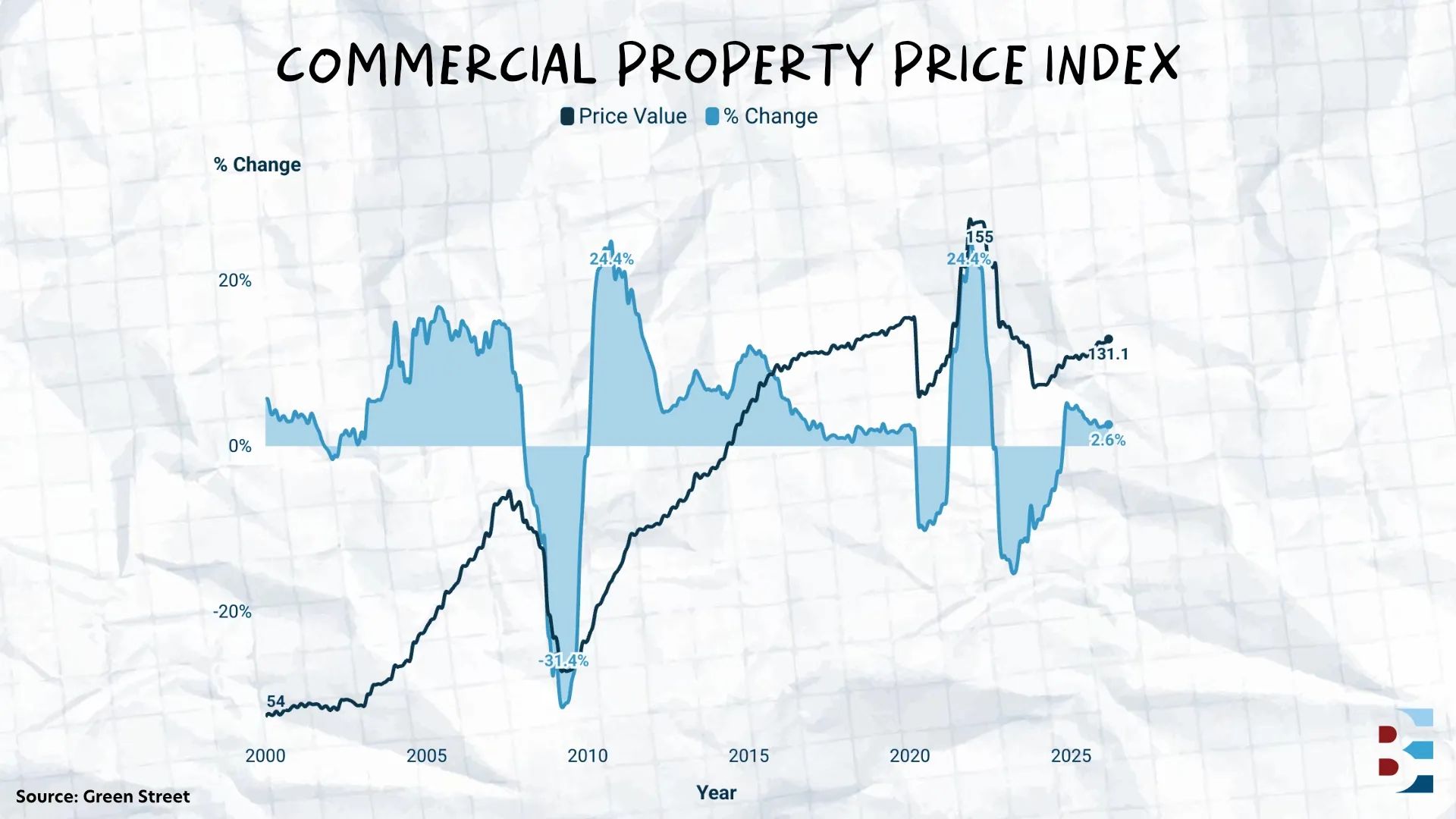
Commercial property prices have grown 2.6% over the last 12 months but remain 15% below their 2022 peak, according to Green Street's Commercial Property Price Index. March's 0.4% monthly gain is being tempered by a 10-year Treasury yield that climbed to 4.4% — its highest level since last summer — as the Iran conflict pushes borrowing costs back up.
🏢 21%
U.S. office vacancy hit a record 21% in Q1 2026, up 60 bps YoY, according to Moody's Analytics — now 4% higher than vacancy was at the start of 2020. Oakland-East Bay led negative absorption with 944K SF of occupancy lost, followed by Austin at 870K SF, with 10 of the last 13 quarters showing net contraction.
🏭 -2.7%
Industrial asking rents for large facilities of 50,000 SF or more have swung from 8.8% compound annual growth in 2019 to -2.7% today, according to CoStar — the first decline in years. Mid-sized and smaller facilities are also softening, though shallow-bay warehouses under 50,000 SF continue to outperform, with asking rents more than 50% above 2010 levels.
🏚️ 90%
Distressed office buildings are selling at discounts of up to 90% off prior peak values, with investors purchasing 204 such properties nationwide last year — up from 133 in 2024 — totaling $5.2 billion, according to MSCI. Rock-bottom pricing is accelerating residential conversions, with more than 90,000 apartment units now in the conversion pipeline nationally.
🚀 BEST EVER INNER CIRCLE
WE JUST LAUNCHED SOMETHING DIFFERENT.

Last month, we quietly opened the Best Ever Inner Circle — a private group for serious CRE operators and fund managers who are tired of solving hard problems alone.
No courses. No beginners. Just experienced operators in a room together, three times a month, working through what's actually happening in their businesses right now.
In our first month, members tackled:
✅ A $375K price retrade on a 60-unit bank foreclosure
✅ A predatory lender threatening to take over a 70-unit Atlanta deal based on DSCR covenants
✅ How to execute a $2.5M–$3M capital raise weeks after just closing another one
✅ Getting listed on Schwab and Fidelity to access RIAs at scale
✅ Building a distressed debt acquisition strategy — buying loans at a discount instead of the real estate itself
Here's what members are actively working on right now:
One member has a 188-unit multifamily deal under contract in Arlington, Texas and is mid-raise. Another just locked up a 283-lot mobile home park portfolio near Birmingham. A fund manager has more qualified borrowers than capital and is building a debt fund from scratch. Two members are deep in lease-up challenges on properties they recently acquired. Several are doing something most operators aren't — going directly to lenders and asset managers to find distressed deals before they hit the market.
This group is not lacking opportunities. It's aligning capital, deals, operators, and systems — all in real time.
👉 We're now accepting applications for our Q2 cohort. Seats are added intentionally and in limited numbers each quarter.
🎙️ THE BEST EVER CRE SHOW
THE DUE DILIGENCE GAPS COSTING LPs MONEY
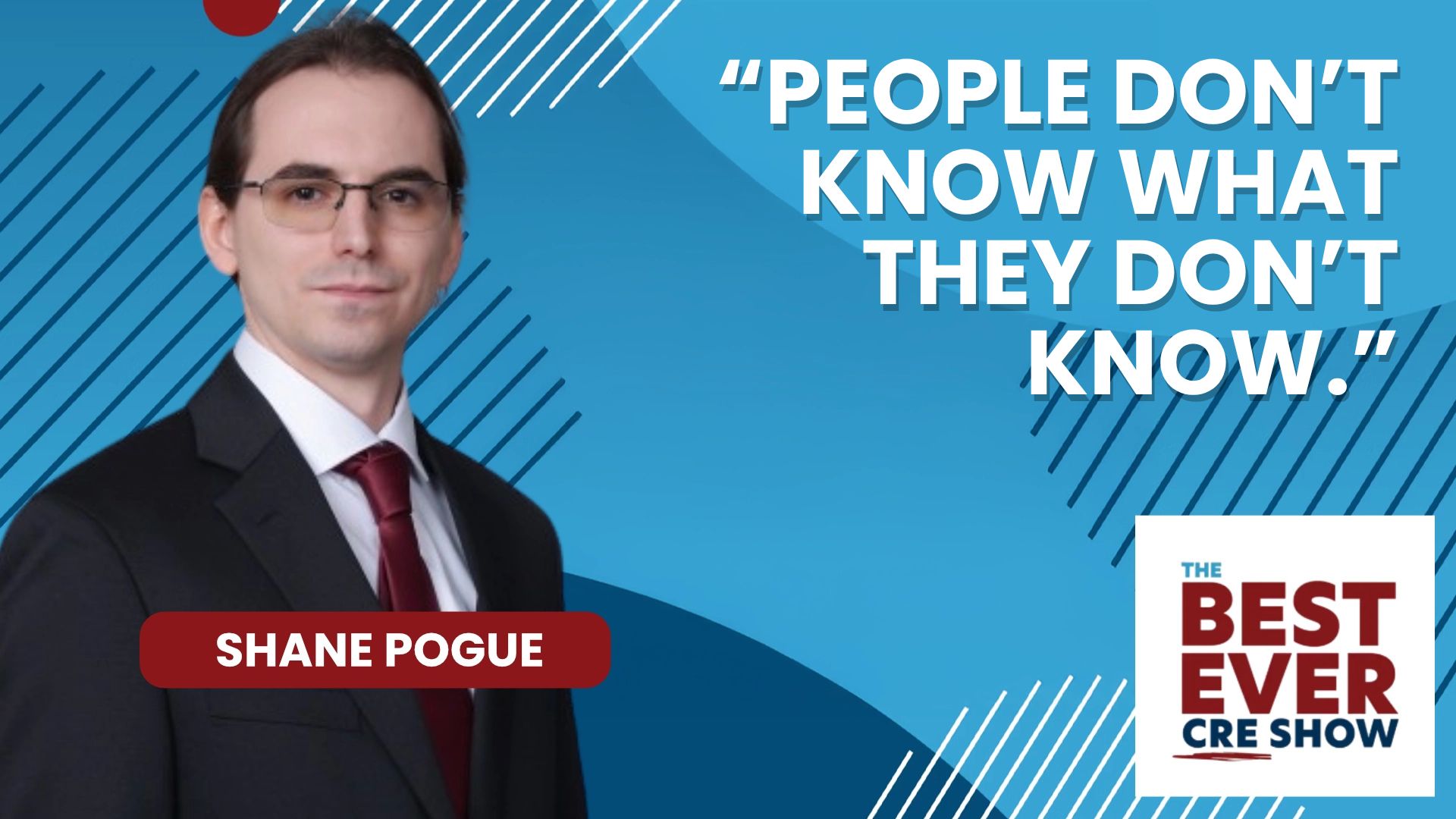
Most LP investors think they've done their homework before wiring money into a private deal. A background check, a Google search, maybe a few calls. Shane Pogue, founder of Aegis Risk Solutions and Investigations, has spent a career finding what that process misses — and it's usually the thing that matters most.
On a recent episode of the Best Ever CRE Show, Pogue joined Pascal Wagner to break down how professional investigative due diligence actually works, and why the standard LP checklist leaves more exposed than most investors realize.
The Aggregate Risk Framework: A single lawsuit tells you almost nothing. A pattern across dozens of entities tells you everything. The process starts by mapping every business an operator has ever touched — LLCs, partnerships, registered addresses — then pulling legal and financial records across all of them. One recent subject came back clean on his primary operating LLC. Across his full entity map, a clear pattern emerged: unpaid bills, liens, and loan-to-value ratios well above market norms. None of it was visible from the front door.
What AI Can't Do: LPs are increasingly running ChatGPT searches as a due diligence shortcut. The problem: most court record systems block automated access entirely, meaning AI returns a clean report not because the record is clean, but because it couldn't get through the door. Hallucinated data and misattributed records compound the risk. AI is a useful starting point, not a substitute for pulling the actual records.
The Cost Equation: Professional investigative due diligence runs $500–$1,000 for a one-time report. For LPs deploying $150,000 or more into a single deal, the fee is less than 1% of the check size — and the only question is whether having the information before the wire goes out is worth it.
Bad actors don't show up looking like bad actors. They show up with a clean LLC, a polished deck, and nothing on the first page of Google. The work of real due diligence is knowing that's exactly what you'd expect to see — and going several layers deeper anyway.
🙏 Thanks for reading!
Stay in the loop with us! If you received this newsletter from someone else, subscribe here. You can also find us on LinkedIn, Instagram, and YouTube.
Have a Best Ever day!
— Joe Fairless