- Best Ever CRE
- Posts
- 💉 How Botox and boxing are saving retail
💉 How Botox and boxing are saving retail
Plus: Fannie and Freddie free-fall, renters are on the move, a big lesson from a bad exit, and much more.

Best Ever CRE Team
March 22, 2026

Together With

👋 Happy Sunday, Best Ever readers!
In today’s newsletter, Botox and boxing save retail, Fannie and Freddie free-fall, renters are on the move, a big lesson from a bad exit, and much more.
Today's edition is presented by Real Estate Alpha, winner of the 2026 Best Ever Pitch Slam. Most funds lock your capital up for years. This one gives it back within 90 days. Fixed 12% annually, 15-19% effective yield due to tax benefits, and fully backed by 700+ operating units across Western Ohio. See why investors are allocating to this structure. Learn more today.
▶️ Now available: Why Control is Stalling Your Capital Raise with Marcin Drozdz of M1 Real Capital. Access the free replay here.
Let’s CRE!
🗞️ NO-FLUFF NEWS
CRE HEADLINES
🏦 Free-Fall: Shares of Fannie Mae and Freddie Mac have lost more than 60% of their value since the start of the year as investors grow impatient with the Trump administration's lack of a clear privatization plan, raising fears of higher mortgage rates.
🔥 Insurance Crisis: U.S. home insurance premiums have climbed 46% since 2021 — nearly three times the rate of inflation — with the average annual cost projected to reach $3,057 in 2026, hitting hurricane- and fire-prone states hardest.
📉 Recession Watch: A machine learning–based economic indicator has put the probability of a recession starting within 12 months at 49%, driven by weak labor data and softening economic conditions across nearly all indicators, with oil price spikes adding further pressure.
🏗️ Outdoor Advantage: Industrial outdoor storage has outpaced traditional industrial assets, with rents averaging $13.14 PSF — a 17.9% premium — and vacancy holding at 2.5% compared to 6.7% for conventional properties, driven by zoning constraints and surging logistics demand.
🏠 Renter Nation: Gen Z has added 6.7 million renter households since 2019, bringing their total to 10.4 million, as shifting demographics reshape U.S. rental demand — with renters 60 and older up 26% over the past decade.
🏆 TOP STORY
SPAS AND GYMS ARE TAKING OVER RETAIL
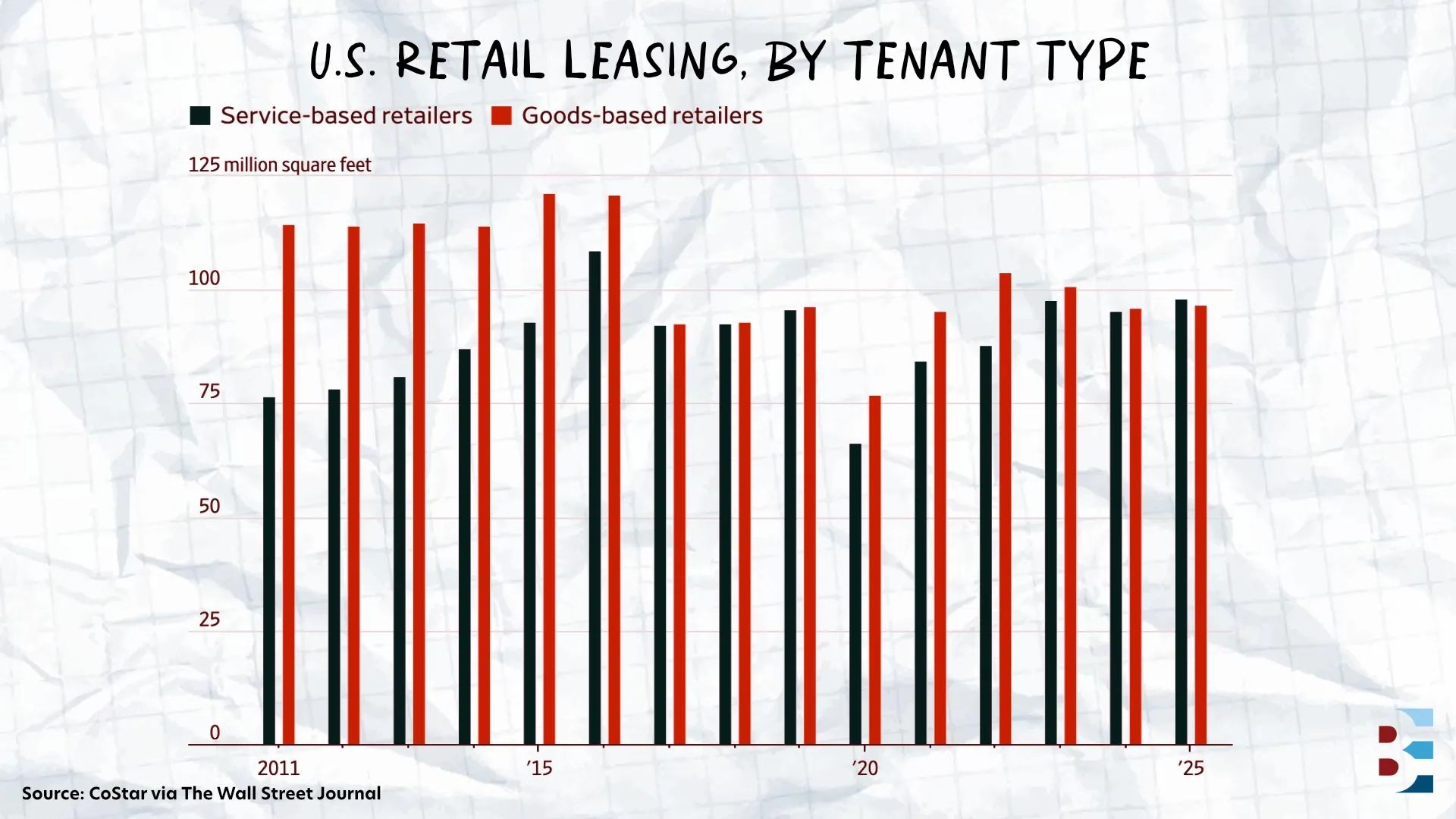
For the last 15 years, physical retail has been written off in roughly the same way, every year, by roughly the same people. Then something quietly happened: Americans stopped buying things and started buying experiences, and they needed somewhere to do it.
Service-based tenants leased just over 50% of total retail square footage in 2025, surpassing goods-based retailers for the first time in recorded history. The margin was narrow — 50.4% to 49.6% — but the structural shift behind it has been building for a decade and a half. In 2010, services accounted for just 40% of retail leasing. The crossover is more than just a blip. It's the destination at the end of a long, one-way road.
E-commerce's erosion of goods retail is well-documented — 16.4% of total U.S. retail sales last year, up from roughly 8% in 2016, as apparel tenants shrank their footprints and legacy chains folded. What's less obvious is what filled the void: the $2.1 trillion U.S. wellness economy, spanning spas, beauty, nutrition, mental wellness, and fitness — each demanding physical space.
The Fitness Surge: Fitness center openings now make up nearly 30% of all service-based leases, up from 20% in 2016. Crunch Fitness alone boosted its leasing activity nearly 50% YoY, signing an estimated 4.27M SF in 2025. Planet Fitness added more than a million members last year and plans to open nearly 200 new locations in 2026, many in boxes vacated by bankrupt chains like Rite Aid and Joann.
The Landlord Case Study: When a liquor store moved out of a Brixmor shopping center in suburban Philadelphia, the company subdivided the 10,200 SF space into four smaller units: an animal hospital, a facial spa, a stretching studio, and a nail salon. The result was 20% higher rent than the previous tenant and more consistent foot traffic throughout the day.
The Supply Picture: U.S. retail vacancy sits at 4.4%, near record lows, even as service leasing hits its own record. New supply is projected to remain constrained through late 2026 and into 2027 — a dynamic supporting pricing stability for existing assets. Transaction volume in 2025 came in 12% above the 2014–2019 average.
Not every corner of the service sector is thriving equally. Food services — historically the largest single category within service leasing — saw its share fall to its lowest level since 2020, even as consumer spending on dining out hit new highs. The disconnect reflects a growing gap between sales performance and leasing appetite among restaurant operators navigating thin margins and chain competition.
THE BOTTOM LINE
Service and wellness tenants have proven they can absorb second-generation space, generate consistent daily traffic, and outperform the goods-based tenants they replaced. With new supply constrained well into 2027 and vacancy near historic lows, well-located retail with the right tenant mix is quietly one of the more durable income plays in the current CRE environment.
🤝 TOGETHER WITH REAL ESTATE ALPHA
FIXED RETURNS. BACKED BY AN ENTIRE PORTFOLIO.

Most passive real estate funds are built on a single deal. One asset. One market. One point of failure. If it underperforms, so do you.
Real Estate Alpha solves this problem. Fixed returns, backed by an entire portfolio. No single deal risk.
Over 700 units already owned, operating, and cash-flowing across Western Ohio at 93-97% occupancy. Fully vertically integrated: property management, leasing, maintenance, and construction all in-house.
Here's the structure that won Pitch Slam 2026:
✅ Protected by Entire Portfolio - Backed by the equity and cash flow of a $75M+ multifamily portfolio.
✅ 12% Fixed (15-19% Effective) - 12% fixed annual return, tax deferral for 8+ years, 15-19% effective yield. More cash in your pocket, without the additional risk.
✅ 90-Day Liquidity After Year 1 - No long-term lockups. Need your capital back? 90 days' notice and it's yours.
✅ Preferred Equity Position - You get paid before the operators do.
✅ 10-Year Track Record, 0 Missed Payments - Paid every December 31st, zero misses since day one.
Click the link below for full details and to book a 15-minute discovery call. No pitch, just a real conversation to see if it aligns with your investment strategy.
This investment round is almost full and closing soon. Accredited investors only.
💰 CRE TRENDS
WHERE RENTERS ARE HEADED IN 2026
American renters are still voting with their feet — and the destination hasn't changed much.
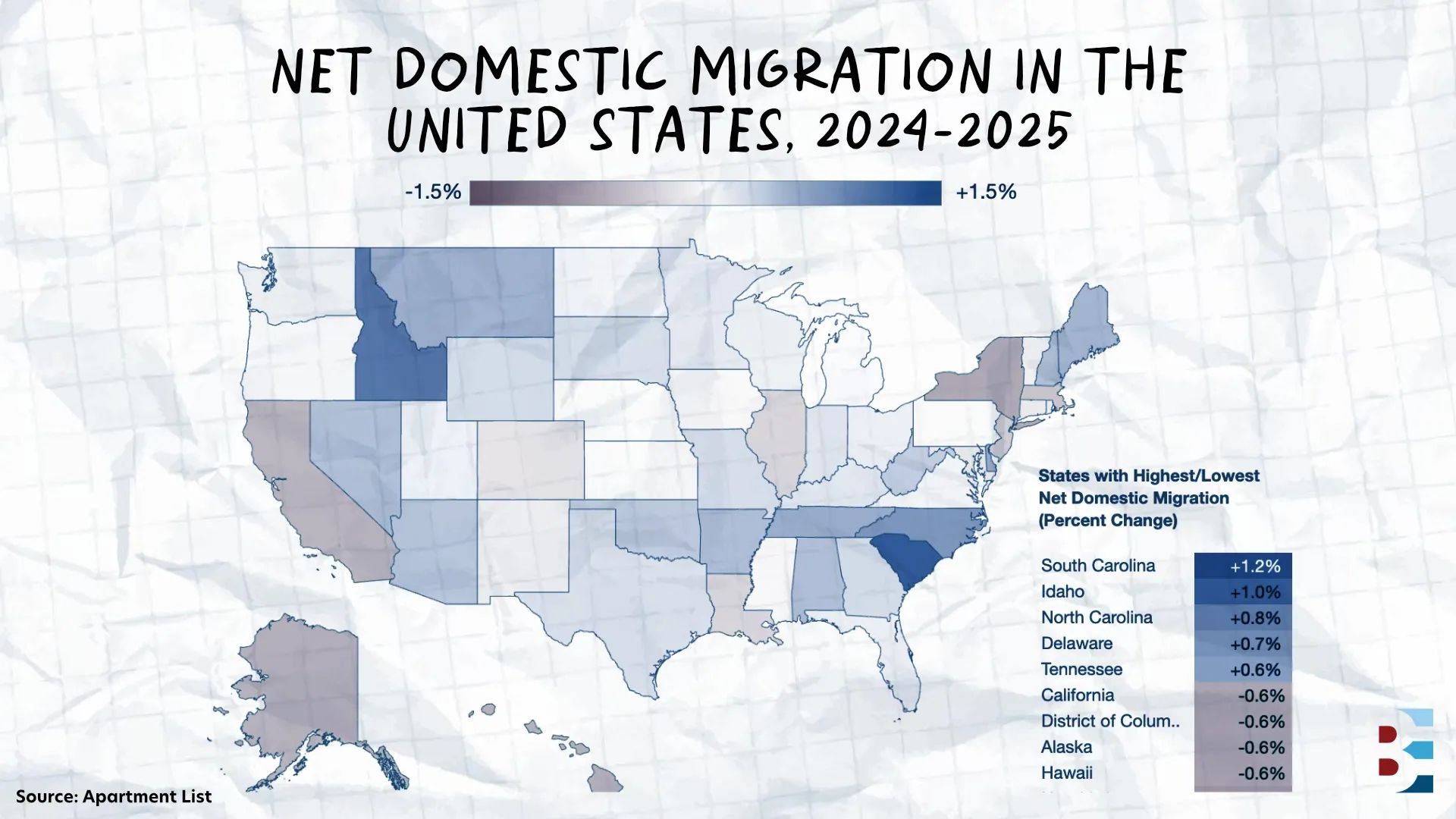
Thirty-nine percent of renters searched for a home in a new metro in 2025, with 24% looking to cross state lines entirely, according to Apartment List's 2026 Renter Migration Report. The high-cost coastal exodus that defined the post-2020 housing market hasn't reversed — it's just matured into something more predictable.
California posted the largest net domestic outflow of any state, with 229,000 more residents leaving than arriving. New York, IL, NJ, and MA round out the top five exporters. The destinations are equally consistent:
The Sun Belt Holds: NC, TX, SC, TN, and AZ led domestic migration gains. South Carolina topped percentage growth for the fourth straight year at 1.2%, adding a net 66,000 residents. North Carolina added 84,000, drawing heavily from nearby VA, SC, and GA.
The Feeder Shift: California renters are cooling on Florida — the Sunshine State's share of CA outbound searches has dropped from 5.3% in 2023 to 3.8% in 2025, with TX, NV, and CO picking up the slack. New York renters are moving in the opposite direction: 11% of outbound NY searches now target FL, pushing it past NJ as the No. 1 destination.
The Secondary Market Signal: Savannah, GA, Durham, NC, and Charleston, SC, lead all metros with more than 60% of inbound searches originating outside the market — the clearest early indicator of where rental demand is building.
The markets to watch are the secondary cities absorbing demand from two directions at once: renters priced out of major metros and remote workers who no longer need to be near one. In Savannah, Durham, and Charleston, that combination is already visible in the search data — and where searches lead today, lease-up pressure tends to follow.

🎙️ THE BEST EVER CRE SHOW
A BIG LESSON FROM A BAD STORAGE EXIT

Most investors know the rule about not putting short-term debt on long-term assets. Alex Pardo learned it the hard way — twice, in the same Mississippi market.
A self-storage operator and host of the Storage Wins podcast, Pardo joined Amanda Cruise and Ash Patel on the Best Ever CRE Show this week to share the deal that nearly unraveled five years of progress in the asset class.
The Setup: Pardo raised $1.45 million from three private lenders on a 12-month term to acquire a 37,000 SF self-storage facility in Mississippi — a pocket listing he bought for $1.2 million, roughly $24–$25 per foot. His plan was to flip it quickly at a premium. What followed was a master class in commercial real estate timing risk:
The Exit Assumption: Pardo listed the facility at $2.2 million and expected to sell within six to twelve months. Instead, the property went under contract two or three times and fell out of due diligence each time, burning through nearly half his loan term before he had a viable buyer.
The Clock Problem: With short-term debt ticking and no buyer materializing, Pardo faced something he'd never experienced — the real possibility of missing a note payment. "I had never, ever put myself in a position where I didn't pay a note when it was due," he said.
The Exit: The facility ultimately sold to the same buyer who purchased his adjacent property, packaging both assets together for $1.99 million. Pardo took a portion back in seller financing and exited profitably — but acknowledged the outcome had more to do with his purchase price than his execution.
The lesson Pardo took away isn't just about debt structure. Pricing aggressively on a commercial asset you need to sell quickly compounds the timeline risk. He noted he probably should have priced to sell from day one rather than anchoring to an aspirational number. "Never underestimate the time that you think it's going to take you to sell one of these commercial assets," he says.
🙏 Thanks for reading!
Stay in the loop with us! If you received this newsletter from someone else, subscribe here. You can also find us on LinkedIn, Instagram, and YouTube.
Have a Best Ever day!
— Joe Fairless