- Best Ever CRE
- Posts
- ⛅ Sun Belt concessions are masking real rents
⛅ Sun Belt concessions are masking real rents
Plus: Evictions get easier, rents recover, small markets win, and much more.

Best Ever CRE Team
March 08, 2026

Together With

👋 Happy Sunday, Best Ever readers! Today is Proofreading Day. So if you spot a typo in today’s newsletter, shame on us.
In today’s newsletter, rent rolls lie, evictions get easier, rents recover, small markets win, and much more.
Today’s edition is presented by Tribevest, the platform helping Sponsors and ICAs structure Fund of Funds and raise capital for private deals. If you’ve ever introduced investors to a deal, you may already be acting as an Independent Capital Aggregator (ICA). The difference between doing it once and building a real business is structure. Learn how through the Institute for Structured Capital.
▶️ Get the replay of our Challenge Workshop with Joe Fairless and Matt Faircloth who opened the room to operators navigating a tough market. From deal flow to LP conversations to lease-up struggles, nothing was off the table. Catch the full replay.
Let’s CRE!
🗞️ NO-FLUFF NEWS
CRE HEADLINES
📋 Eviction Fast-Track: HUD has reversed pandemic-era eviction protections, allowing landlords to move on nonpayment with as little as five days' notice, affecting more than two million households as proposed work requirements and two-year term limits remain open for public comment.
🏘️ Rents Recover: U.S. apartment occupancy and effective asking rents have posted back-to-back monthly gains for the first time in two years, according to RealPage, with occupancy reaching 94.8% in February as tech-hub markets including San Francisco and New York lead annual rent growth of 4.5%–9%.
💻 Amazon Cuts: Amazon has announced plans to cut 49,000 desks and reduce its global office vacancy from 31% to 23%, a shift that could impact more than 14M SF of space through lease expirations, subleases, and hibernated offices.
🏢 Pipeline Pause: U.S. office construction has contracted to 28.9M SF nationally as developers pause projects and await demand, with Boston's pipeline falling to less than one-quarter of its 2024 peak and West Palm Beach emerging as Florida's most active market.
🛍️ Retail Push: U.S. retailers are pressing ahead with leasing and development despite ongoing tariff uncertainty, with national net absorption turning positive in the back half of 2025 at 5.2M SF and 11.9M SF in Q3 and Q4, respectively.
🏆 TOP STORY
SUN BELT CONCESSIONS ARE MASKING REAL RENTS
The rent roll says one thing. The rent check says another.
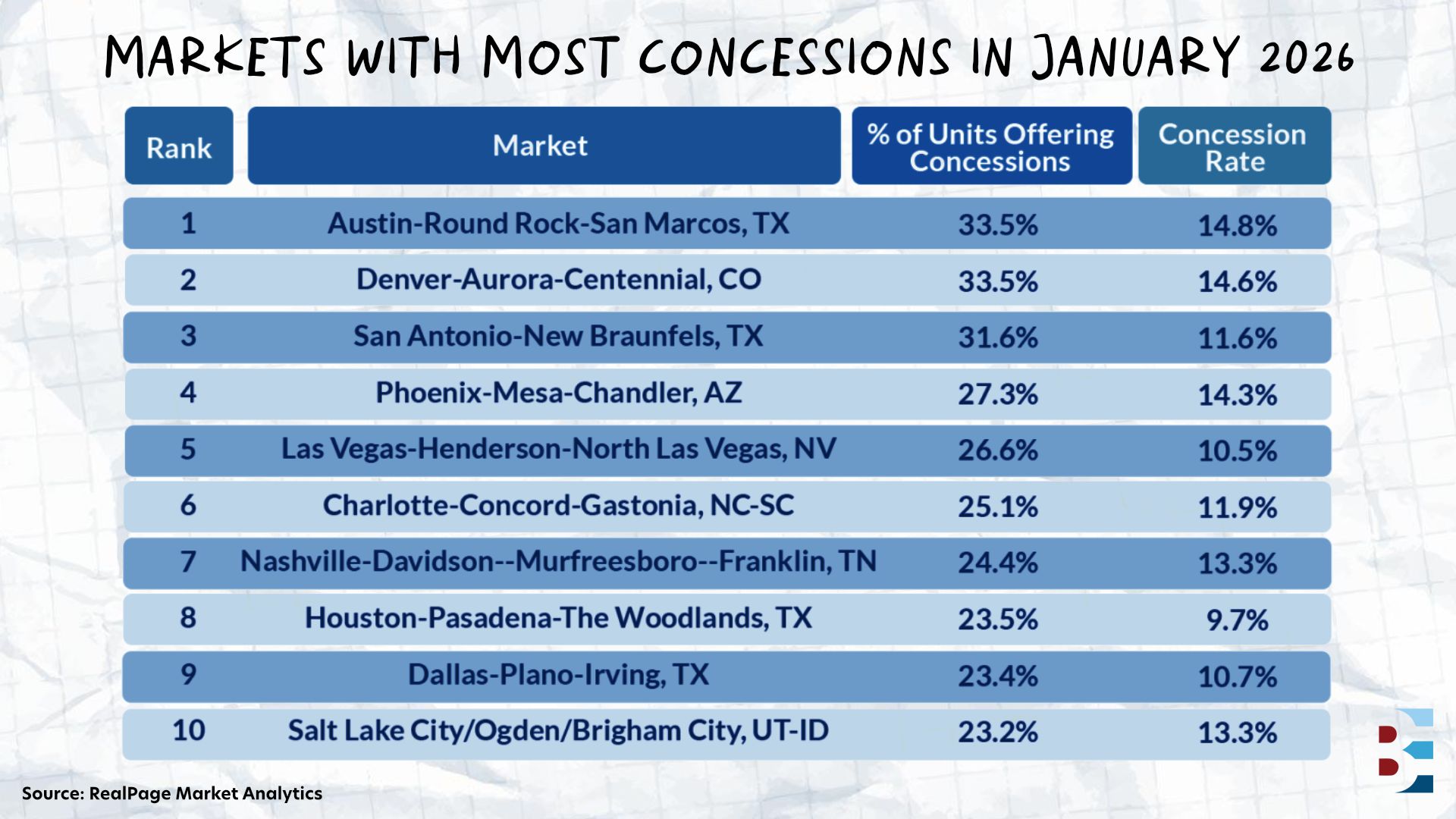
Across high-supply Sun Belt markets, the gap between asking rents and what tenants are actually paying at move-in has quietly widened. For investors underwriting acquisitions or managing debt covenants, that spread is becoming impossible to ignore. New data from RealPage shows concession usage rose across all four national regions in January, but the divergence between markets tells the real story of where multifamily fundamentals actually stand.
The South led the country with concessions in use on 20.5% of stabilized units. The West wasn't far behind at 16.2%. The Northeast and Midwest, by contrast, came in at 12.8% and 10.7% — restrained by comparison, and a reflection of how much less construction pressure those regions have absorbed over the last several years.
Austin and Phoenix: Two of the hardest-hit metros for concession depth — Austin at 14.8% in January and Phoenix just behind — are also seeing penetration rates approaching one-third of stabilized units. At that level, the achieved rent at move-in is materially below the face rate on a significant portion of the rent roll.
Texas Dominates: Four major Texas markets ranked among the top concession metros nationally in January. Houston joined the top 10, displacing Fort Worth — a sign this isn't seasonal noise but a sustained response to elevated supply.
The Margin Math: Across the top 10 concession markets, discount depths ranged from roughly 10% to 15%. For stabilized assets carrying concessions on a third of units, that wedge can drag effective rent growth even in nominally full properties — particularly when discounts recur rather than burn off after lease-up.
For buyers evaluating trailing income streams, the implication is direct: Properties that appear to be holding rents steady on paper may be quietly eroding margins through richer upfront offers and extended free-rent periods. The same dynamic puts pressure on existing owners negotiating debt covenants tied to DSCR and in-place NOI.
THE BOTTOM LINE
The lower concession figures in the Midwest and Northeast signal tighter near-term fundamentals and less execution risk for investors prioritizing predictable cash flow. In the Sun Belt, markets like Austin and Phoenix tell a different story — concession depth near 15% and penetration approaching one-third of stabilized units will pressure current yields. San Antonio is in the same boat, and all three could set the stage for outsized rent gains once new supply slows and incentives roll back.
🤝 TOGETHER WITH TRIBEVEST
GREAT CAPITAL RAISERS DON’T START WITH INFRASTRUCTURE

Great capital raisers don’t start with infrastructure.
They start with interest.
A deal they believe in.
Investors they trust.
A network that wants access.
But moving from interest to a real capital raising project requires understanding how to structure Fund of Funds, work with Sponsors, and manage investor relationships responsibly.
The Institute for Structured Capital was created to teach exactly that.
Inside ISC, you’ll learn:
How capital aggregation works
How to structure Fund of Funds
How to work professionally with Sponsors
How to build a repeatable capital raising process
If you're thinking about raising capital for deals, ISC is the best place to start.
💰 CRE TRENDS
SMALL MARKETS ARE WINNING THE CRE PRICE WARS
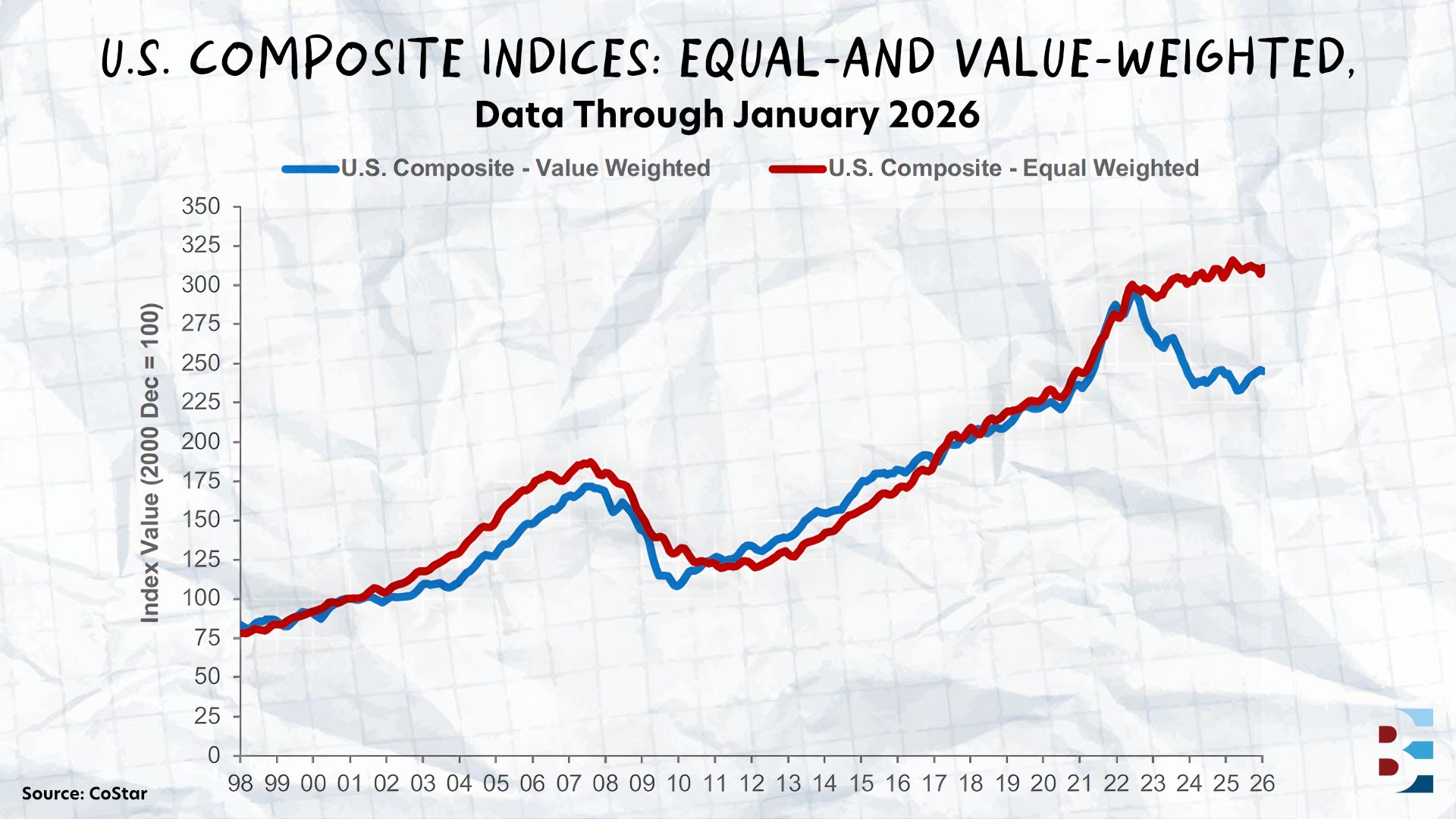
Commercial property values moved in opposite directions in January, according to new CoStar data. While major city investment-grade assets slid 0.4% and now sit 17% below their mid-2022 peak, smaller market properties quietly gained ground — a divergence that's reshaping where opportunistic capital is flowing in 2026.
The equal-weighted CoStar index — which tracks the higher volume of lower-priced deals typical in secondary and tertiary markets — rose 1.3% in January and 1.1% annually. The general commercial segment, which captures most small-town transactions, led all categories with 2.6% annual growth.
Transaction volume: Total commercial repeat-sale volume for the trailing 12 months hit $146.8 billion, up nearly 20% YoY — driven largely by secondary and tertiary market deals.
Buyer leverage: Average price-to-asking ratios fell to 92.5% in January, meaning buyers are securing meaningful discounts off listed prices.
Distress remains contained: Distressed sales accounted for just 2.4% of all transactions, suggesting the broader market isn't in freefall despite the valuation gap.
Analysts caution the divergence may not hold. Potential Fed rate cuts later in 2026 could shift capital back toward major markets, narrowing the pricing gap that has made small-town commercial assets attractive. Average time on market ticked down slightly to 174 days, though more sellers pulled listings — a sign that caution on both sides of the table hasn't fully lifted.
▶️ GET THE REPLAY
WHAT’S YOUR BIGGEST OPERATOR CHALLENGE?

Every operator is wrestling with something right now. Deal flow. Lease-up struggles. Insurance costs. Tough LP conversations. You name it.
So we did something about it.
We sat down with Joe Fairless and Matt Faircloth for a candid, live working session where serious operators brought their real challenges to the table — and solved them together. If you missed it, you can watch the full replay now for free.
Here's what you'll hear:
🔍 Real challenges, worked through in real time
🤝 Candid, operator-to-operator problem solving
💡 A new approach to staying connected and supported all year long
🎙️ THE BEST EVER CRE SHOW
WHAT MOST INVESTORS MISS IN TRIPLE-NET DEALS
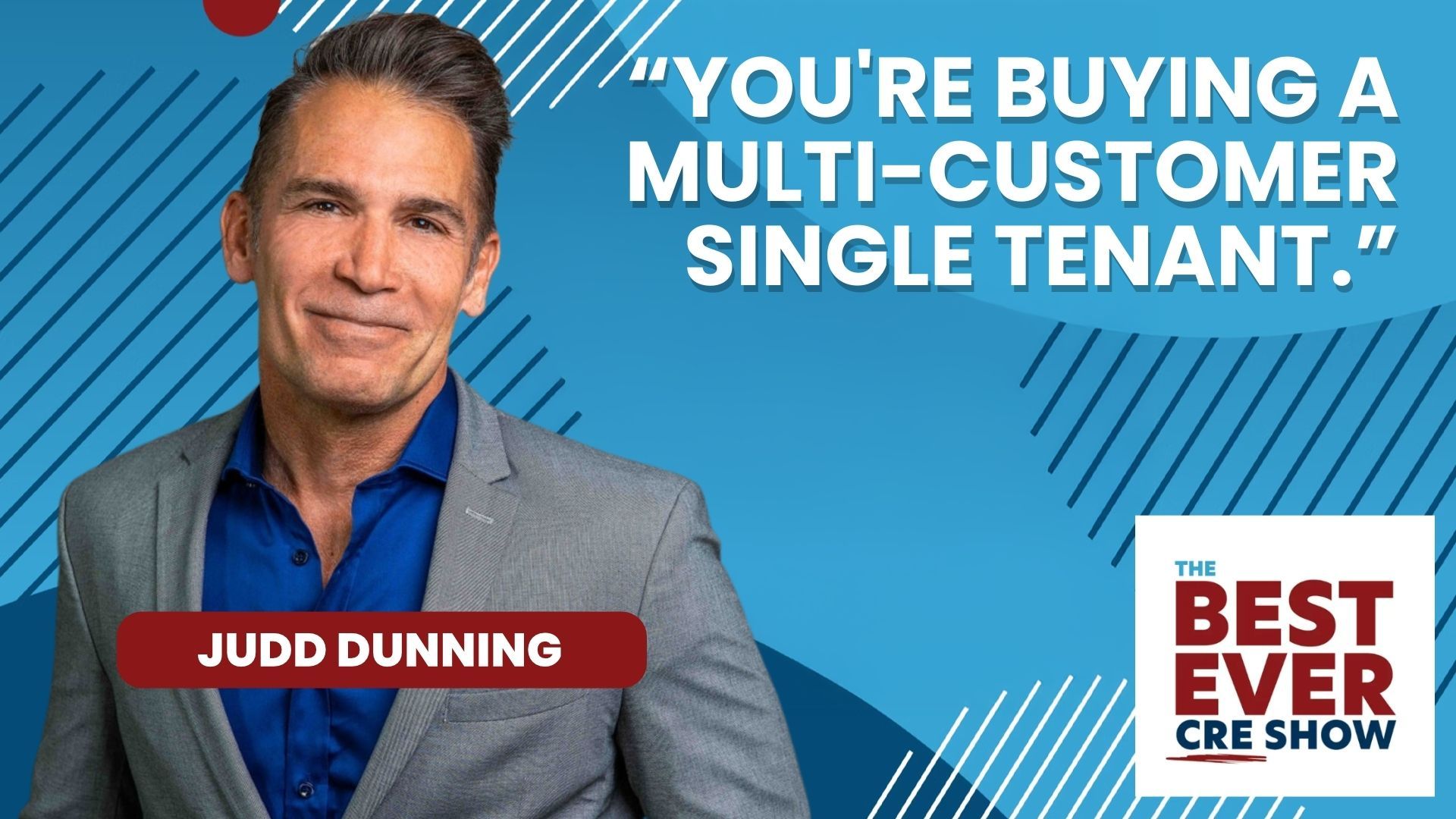
Most investors evaluating a triple-net deal stop at the tenant. Judd Dunning says that's the wrong place to stop.
At the Best Ever Conference, Dunning — president of DWG Capital Group and DWG Capital Partners — joined Pascal Wagner on the Best Ever CRE Show to break down how he underwrites industrial sale-leasebacks, and why the tenant is only half the story.
His framework starts with customer concentration. A single-tenant industrial asset looks clean on paper, but if that tenant derives the majority of its revenue from one or two customers, the exposure is far greater than the lease structure suggests. Dunning's rule: no single customer should represent more than 20–30% of a tenant's revenue base.
The analogy: Think of it like a multifamily building. If one tenant in a ten-unit property leaves, you're down 10%. If your industrial tenant loses its anchor customer, you could be facing vacancy on the entire asset. Diversified customer bases effectively turn a single-tenant property into a multi-tenant one.
The red flag: Businesses dependent on a single government contract — say, exclusively DOD work — carry outsized risk. One cancelled contract and the building goes dark.
The underwriting cost: By the time Dunning's team gets to a deal decision, they've typically spent $100,000 on accountants and quality-of-earnings reports vetting the tenant's business fundamentals.
The goal, he says, is to manufacture the credit profile of a Starbucks or Walgreens out of American small and mid-cap businesses — knowing the work happens before the lease is signed, not after.
🎙️ For more on how Dunning underwrites industrial sale-leasebacks, listen to the full episode here.
✅ BEST EVER TALENT SOLUTIONS
NOW HIRING: VP OF INVESTOR RELATIONS

Best Ever Talent Solutions is partnering with DWG Capital Group to hire the VP of Investor Relations in Capital Markets. This is a well-compensated senior role for someone with existing capital relationships, CRE experience, and the ambition to help scale a boutique firm from $100M to $500 M+ AUM. DWG is looking for the ideal candidate to raise capital across real estate deals and our Great American Industrial Fund.
If you or someone you know would be a great fit, you can apply today.
🙏 Thanks for reading!
Stay in the loop with us! If you received this newsletter from someone else, subscribe here. You can also find us on LinkedIn, Instagram, and YouTube.
Have a Best Ever day!
— Joe Fairless