- Best Ever CRE
- Posts
- 🚀 The office conversion pipeline just exploded
🚀 The office conversion pipeline just exploded
Plus: The war on hidden fees, apartment construction disappears, the Midwest makes a comeback, and much more.

Best Ever CRE Team
April 05, 2026

Together With

🐰 Happy Easter, Best Ever readers!
In today’s newsletter, office conversions explode, the war on hidden fees, apartment construction disappears, the Midwest makes a comeback, renters move back home, and much more.
This edition is presented by Equity Institutional Services. Most sponsors know IRA capital exists — few know how to access it without slowing down their raise. The right custody partner changes that. Equity Institutional Services can show you what smooth IRA participation actually looks like. Learn more.
🥊 Most CRE investors are fighting over the same multifamily deals — and leaving a high-cash-flow, low-management asset class almost entirely to themselves. The Triple Net Fast Track course could change how you think about your next acquisition. Check it out here →
Let’s CRE!
🗞️ NO-FLUFF NEWS
CRE HEADLINES
🏠 Fee Crackdown: The FTC has launched a rulemaking process targeting hidden rental fees, following a $24 million settlement with Greystar over advertised rents that excluded mandatory charges, with a public comment deadline of April 13.
🏗️ No-Build Markets: Apartment construction has disappeared entirely in 16 major U.S. markets, according to RealPage, up from 10 a year ago, with Youngstown recording no new units since 2018 even as national occupancy sits at 98.9%, the tightest in the country.
🏢 Blind Spots: Four out of five CRE and workplace executives say they lack the spatial data needed to make confident office space decisions, with 36% relying on gut instinct for layout changes, leaving nearly a quarter of unoccupied office space heated and cooled at unnecessary cost.
🏪 Net Lease Surge: Single-tenant net lease retail transactions have climbed to the third-highest count on record, with private investors capturing 71% of dollar volume as 1031 exchange activity reached its highest level since before 2024.
🏥 Senior Compression: Senior housing cap rates have compressed across nearly all property types for a second consecutive year, with active adult Class A assets averaging 5.32% in spring 2026 as investor demand for lower-acuity properties continues to build.
🏆 TOP STORY
THE OFFICE CONVERSION TREND JUST HIT ANOTHER GEAR

Apartment construction just hit a two-year low in permits. Meanwhile, the pipeline of office buildings being converted into apartments has nearly quadrupled since 2022 — reaching 90,300 units at the start of this year. The industry isn't waiting for ground-up development to catch up.
Office conversions now account for nearly half of all adaptive reuse projects in the country, and the activity is spreading well beyond the markets that led the early wave. Three metros more than doubled their pipelines in the past year alone, and the geographic footprint of conversion activity has expanded from a handful of dense coastal cities to mid-sized markets across the Midwest and South.
New York, D.C., and Chicago: New York leads with 16,358 units in the conversion backlog — up 97% YoY — driven by strong housing demand and an older building stock well-suited to residential layouts. Washington, D.C. follows with 8,479 units and Chicago with 4,360, with both markets drawing 64% of their adaptive reuse activity from office conversions.
The Fastest Movers: Philadelphia jumped from 18th to 7th with a 119% YoY increase in its pipeline, while Denver surged from 15th to 6th, adding 114% more planned units. St. Louis more than doubled its conversion total. All three are markets where local policy alignment, affordability pressure, and a deep stock of underused downtown offices have accelerated the timeline.
Not All Markets Are Growing: Seven of the top 20 metros recorded YoY declines in their conversion pipelines, up from three last year. Minneapolis dropped 22%, Kansas City fell 19%, and Pittsburgh and Jacksonville each declined 11% — a reminder that financing conditions, zoning complexity, and local demand dynamics determine whether projects move forward.
The regional picture has shifted as well. The Northeast leads with 28,552 planned units, but the South is closing fast at 26,527, reflecting broader population growth and a growing stock of struggling suburban office parks now entering the mix.
THE BOTTOM LINE
The pipeline numbers are a leading indicator, not a guarantee. Conversions still take years to deliver, and the gap between planned and completed units is wide. But for markets where housing supply is constrained and office vacancy remains elevated, conversions are increasingly the path of least resistance — and capital is following that logic into markets it largely ignored three years ago.
🤝 TOGETHER WITH EQUITY INSTITUTIONAL SERVICES
CAPTURE MORE IRA CAPITAL

Experienced sponsors know IRA capital is an option. What separates the smooth raises from the stalled ones is having the right custody and servicing partner behind the scenes.
Equity Institutional Services helps sponsors unlock self-directed IRA capital by providing the infrastructure needed to support retirement-account commitments smoothly and professionally.
Why sponsors choose Equity Institutional Services:
A Larger Investor Channel: IRAs represent one of the largest pools of investable capital in the U.S., yet many sponsors still underutilize retirement accounts in their raise process. Equity Trust helps make IRA participation a standard part of your offering.
Simplified IRA Participation: Equity Trust streamlines how investors use self-directed IRAs across private offerings, real estate, and alternative assets—reducing friction for both sponsors and investors.
Built for Sponsors: Work with a custodian designed for private-market investing, so you can expand access to IRA capital without adding operational complexity to your team.
Sponsors who intentionally incorporate IRA participation—and refer investors to the right custodian—are better positioned to capture a larger share of accredited capital.
Learn how Equity Institutional Services supports sponsors and their IRA investors.
💰 CRE TRENDS
WHERE THE U.S. IS GROWING, AND SHRINKING
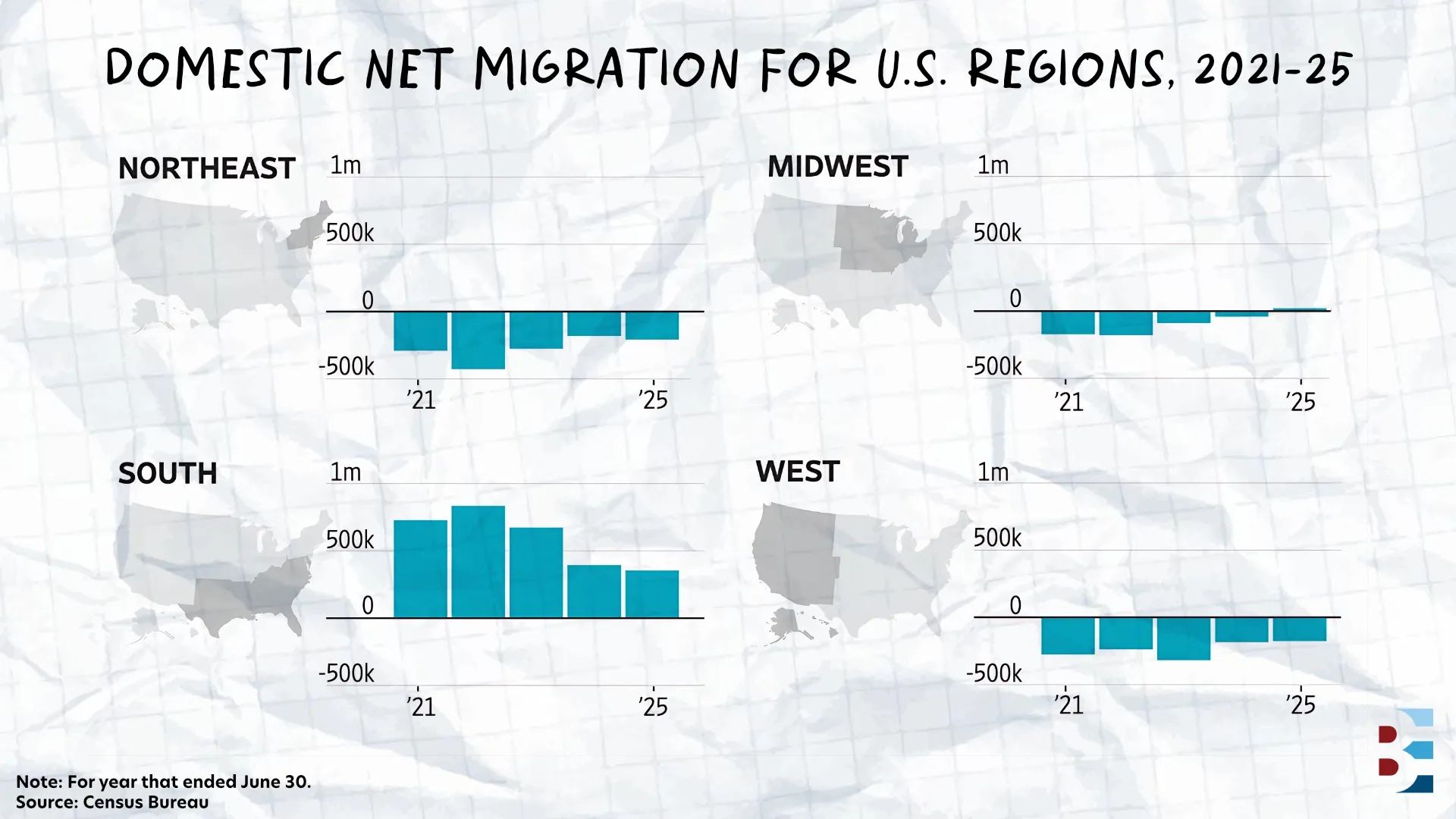
The Midwest hasn't added more domestic migrants than it lost in years. That changed in the 12 months through June 2025, when the region joined the South as the only major U.S. regions posting net domestic migration gains — a shift driven by affordability and two resurgent state capitals.
Columbus, OH, and Lansing, MI, both flipped from net domestic migration losses to gains, helping tip the regional balance. A few other trends stand out:
Carolina Metros Are Surging: Myrtle Beach, SC, grew 3.2% in the latest period — the fastest pace in the Carolinas — while Spartanburg, SC, and Wilmington, NC, also posted above-average gains driven almost entirely by domestic movers.
Urban Cores Are Losing Ground to Suburbs: Central counties of the 53 largest U.S. metros grew just 0.3%, while their suburban counties grew at three times that rate. Small and mid-sized metros outpaced both.
Immigration's Role Is Shrinking: A significant slowdown in international migration has made domestic movement the primary driver of population change — putting even more weight on affordability as a deciding factor for where people land.
Two-thirds of U.S. counties now record more deaths than births, up from fewer than half as recently as 2019, leaving domestic migration as the dominant force shaping where rental demand builds next.
⏩ TRIPLE NET FAST TRACK
STOP COMPETING FOR MEDIOCRE MULTIFAMILY DEALS

If you're tired of getting outbid on 5% cash-on-cash multifamily deals — or burned out managing tenants and repairs — Triple Net investing might be the lane change you've been looking for.
In this Fast Track course, NNN expert Ash Patel and multifamily veteran Matt Faircloth walk you through 5 real deal case studies, covering:
Finding mispriced retail and office deals others overlook
Partnership structuring for larger acquisitions
Lease negotiation tactics that can take returns from 12% to 35% CoC
Wholesaling NNN properties off-market with minimal competition
You'll also get Ash's underwriting templates and broker call scripts.
Originally $797 — now $497.
🎙️ THE BEST EVER CRE SHOW
WHY MULTIFAMILY’S NEXT SURGE IS ALREADY LOADING

Multifamily demand hasn't disappeared. It's sitting in spare bedrooms across the country, waiting for the job market to recover.
The U.S. added roughly 115,000 jobs in all of 2025 — a number that once represented a single month of gains. That slowdown is hitting household formation directly, with the share of young adults living with family climbing back toward its highest levels in recent memory.
This week on the Best Ever CRE Show, John Chang joined Matt Faircloth to break down why the sector's next absorption surge may be closer than the current fundamentals suggest — and how investors should be positioning now. Chang and Faircloth drew a direct parallel to the early 2020s, when a similar spike in adults living at home preceded a sharp surge in absorption once conditions improved.
The Supply Equation: Multifamily starts are down more than 70%, and units under construction nationally have fallen over 50%. New supply is contracting at exactly the moment when a demand recovery could trigger rapid absorption — a combination Chang expects to produce outsized rent growth once the job market stabilizes.
Where to Play It: Northern markets like Chicago, Seattle, and Ohio metros are posting stable 3–4% rent growth now with lower volatility. Sun Belt markets are trading at a discount with more supply overhang, but Chang sees stronger upside potential there as employment engines in cities like Phoenix, Charlotte, and Atlanta build momentum.
How to Underwrite It: Don't plan for rate relief. Chang expects capital costs to remain elevated and recommends conservative vacancy assumptions in years one and two, especially in markets still absorbing excess supply.
The window to enter ahead of the recovery is open, Chang says. But it requires patience and discipline on the underwriting side.
🎓 BEST EVER TIPS
A POWERFUL TOOL FOR BUILT-IN APPRECIATION

LOOK FOR TAX INCREMENT FINANCING (TIF) DISTRICTS
Tax Increment Financing is a municipal funding mechanism that creates predictable appreciation opportunities. TIF districts are designated geographic areas where municipalities freeze property tax values at current levels. As the neighborhood improves and property values rise, that extra tax revenue — the "increment" — gets reinvested back into the district instead of the general fund, paying for roads, parks, and infrastructure upgrades.
In his recent book, Value Over Volume, investor Tanh Truong explains: "TIFs make the area more attractive to private developers. These developers know that by investing in the neighborhood, property values will rise, meaning they can potentially make a nice profit. It's a win-win situation — communities get the upgrades they need, and investors get a chance to make some money." Seeking out TIF districts can give you a built-in catalyst for appreciation because the neighborhood improvements are already funded and essentially guaranteed.
📚 For more tips and stories like these, Value Over Volume is available now.
🙏 Thanks for reading!
Stay in the loop with us! If you received this newsletter from someone else, subscribe here. You can also find us on LinkedIn, Instagram, and YouTube.
Have a Best Ever day!
— Joe Fairless