- Best Ever CRE
- Posts
- 🏗️ Why are cities banning self-storage?
🏗️ Why are cities banning self-storage?
Plus: The Airbnb-ization of CRE, insurance claims surge, office heats up, the housing shortage grows, and much more.

Best Ever CRE Team
April 16, 2026

Together With

👋 Hello, Best Ever readers!
In today’s newsletter, cities fight self-storage, the Airbnb-ization of CRE, insurance claims surge, office heats up, the housing shortage grows, and much more.
Today’s edition is presented by Real Estate Alpha, Pitch Slam 2026 winner. Most real estate funds outsource property management, leasing, construction, and maintenance to third parties. Real Estate Alpha handles everything in-house, across 700+ units in Western Ohio. Fixed 12% annually, 15-19% effective yield due to tax deferral, and backed by a fully vertically integrated operation. Discover why accredited investors are allocating to this structure. Learn more.
🎯 FREE WEBINAR | Three Private Debt Strategies Targeting 16.4% to 20.4% Annual Cash Flow — April 23 at 1 pm ET. Learn exactly how to put private credit to work in your portfolio. Save your spot.
Let’s CRE!
🗞️ NO-FLUFF NEWS
CRE HEADLINES
⚖️ Liability Surge: Premises liability claims against commercial landlords have jumped from 4,516 cases in 2022 to 5,632 in 2024, pushing general liability insurance rates up 30% or more in Q4 2025 as nuclear verdicts and aggressive plaintiff marketing drive a volatile coverage market.
🗺️ OZ Expansion: The Treasury Department and IRS have issued guidance for states to nominate census tracts as qualified opportunity zones under the One Big Beautiful Bill, opening 25,332 eligible tracts — including 8,334 rural areas — for designation beginning January 1, 2027.
🏆 Midwest Wins: Indianapolis has topped Arbor Realty Trust and Chandan Economics' Spring 2026 Multifamily Opportunity Matrix, with Milwaukee, Chicago, Cincinnati, and Columbus also ranking among the top performers as Midwest metros post strong occupancy gains and competitive yields.
🏚️ Office Reset: Distressed office sales have surpassed 200 transactions last year — nearly double 2023 volume — as foreclosure and bankruptcy-linked deals top $5 billion, driving steep urban discounts and a wave of office-to-residential conversions in New York, Chicago, and Los Angeles.
🎓 Young Renters: Washington, D.C., Omaha, and Boston have topped Glassdoor and Redfin's 2026 rankings of the best large cities for recent college graduates, with three Texas metros — Dallas, Houston, and Austin — also making the top 10 as affordability and job diversity drive location decisions.
🏆 TOP STORY
WHY SOME CITIES ARE BANNING SELF-STORAGE
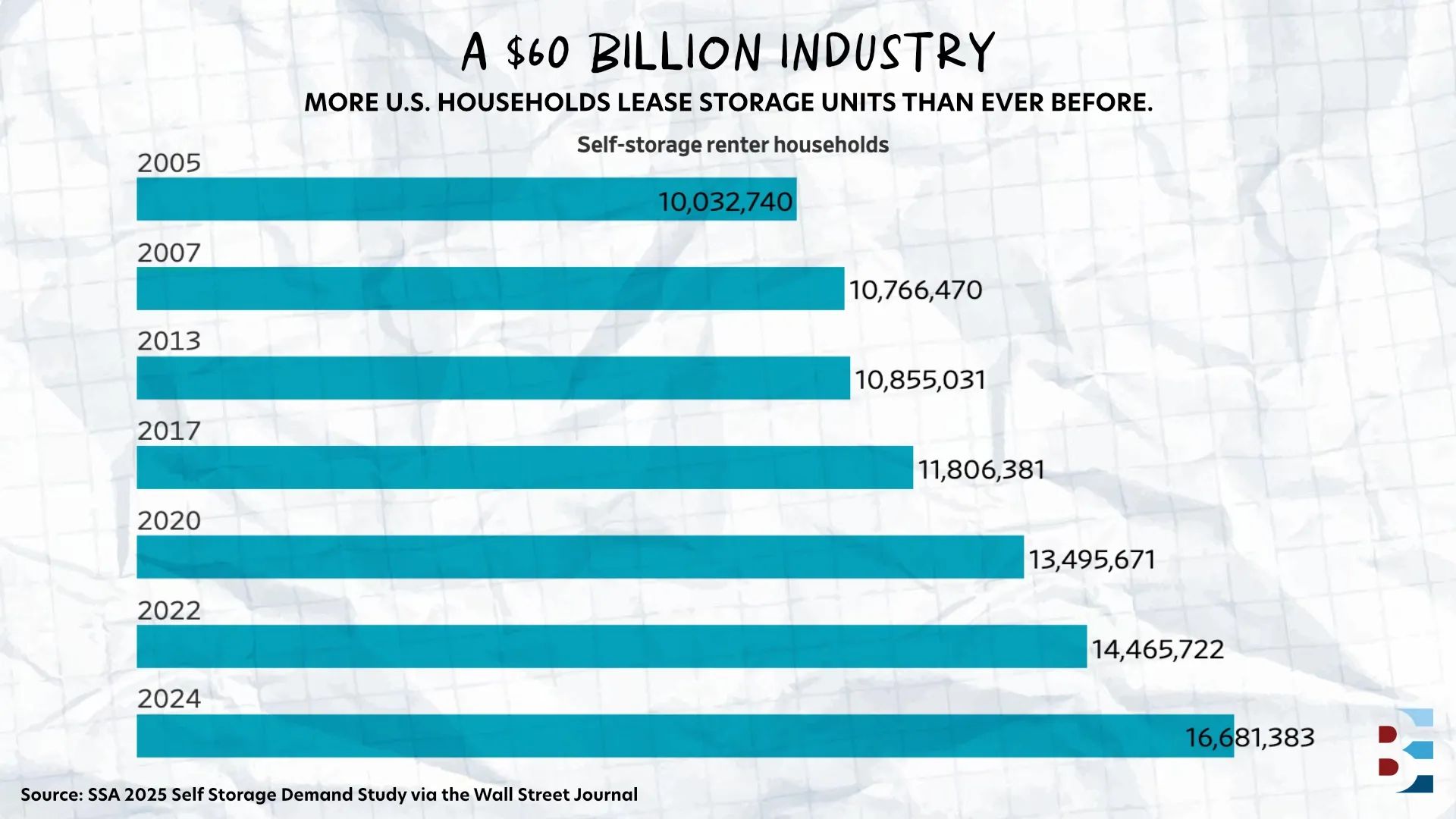
Self-storage has quietly become one of the most resilient asset classes in CRE, built on a simple behavioral reality: Americans accumulate more than they can house, and they'll pay monthly to avoid dealing with it. The industry now generates $60 billion a year, more than 16 million U.S. households are paying rent on a unit, and another 164M SF of new supply is in development.
Now, the towns hosting those facilities are starting to push back. Since 2019, bans on new self-storage facilities have been enacted in parts of at least 15 states.
Denver prohibits storage facilities near light-rail stations, where the city is targeting housing development. Providence enacted a citywide moratorium in 2023 — placing self-storage alongside prisons, incinerators, and slaughterhouses on its prohibited-use list. Delta Township, MI, is pushing facilities off commercial corridors and into industrial zones. The message from municipalities is consistent: Storage takes up land without generating street life, jobs, or tax base.
The friction is sharpest where the industry's economic logic conflicts most directly with local planning goals:
Zoning Pressure: Cities with housing shortages are increasingly treating storage sites as opportunity cost — land that could absorb residential or mixed-use development. That political calculus is accelerating as the national single-family deficit hits 10 million units.
The Design Response: Operators are adapting. Some are embedding storage inside existing buildings — Stuf Storage operates a facility inside the SAG-AFTRA building on Wilshire Boulevard in Los Angeles, carving 200 units out of 17,000 SF. Others are adding laundromats or restaurants to their street frontage to ease approval. Mixed-use configurations, while costlier, are becoming the path of least resistance in supply-constrained urban markets.
The Pricing Gap: Even as new customer demand softens — a byproduct of the sluggish housing market — operators are holding existing tenants at elevated rates. REIT data from TractIQ shows the average spread between advertised street price and achieved price hit 18.9% in Q4 2025. That gap is a margin story operators are quietly benefiting from.
Occupancy, meanwhile, is showing early signs of recovery. REIT data — which covers roughly 30% of the industry — shows occupancy increasing YoY for the first time since 2021. The industry's fortunes track the housing market closely, and with transaction volume still depressed, existing customers are staying put longer. Unit size correlates directly with tenure: the larger the unit, the longer a tenant stays.
THE BOTTOM LINE
Zoning is becoming a first-order diligence item for storage investors. Municipal resistance is real, accelerating, and concentrated on exactly the commercial corridors where storage has historically performed best. Operators embedding facilities into existing structures — or pairing them with mixed-use components — are finding the clearest path to approvals. Building new, standalone storage facilities on prime commercial streets has a shrinking runway in a growing number of markets.
🤝 TOGETHER WITH REAL ESTATE ALPHA
CONTROL EVERYTHING. OUTSOURCE NOTHING.

Most operators outsource property management. They hand control to a third party, collect a quarterly report, and hope the numbers look good.
When they don’t, it’s already too late.
Real Estate Alpha is fully vertically integrated. Property management, leasing, maintenance, and construction, all managed in-house.
Every metric tracked daily, not quarterly. Problems get caught in hours, not months.
The result: 700+ units at 93-97% occupancy, $700,000+ in monthly cash flow, 7-day unit turns, lightning fast maintenance, and 10 years without a single missed investor payment.
Here’s the structure investors are allocating to:
✅ 12% Fixed (15-19% Effective) - 12% fixed annual return, tax deferral for up to 9 years, 15-19% effective yield. More cash in your pocket, without the additional risk.
✅ Protected by 700+ Units - Backed by the equity and cash flow of a $75M+ multifamily portfolio ($32.5M operator equity protection, $700,000+/mo cashflow).
✅ 90-Day Liquidity After Year 1 - No long-term lockups. Need your capital back? 90 days' notice and it's yours.
✅ Preferred Equity Position - You have a preferred position in the capital stack and get paid before the operators do.
✅ 10-Year Track Record, 0 Missed Payments - Paid every December 31st, zero misses since day one.
Click the link below for full details and to book a 15-minute discovery call. No pitch, just a real conversation to see if it aligns with your investment strategy.
Only a small allocation remains. First-come, first-served. Accredited investors only.
💰 CRE BY THE NUMBERS
OFFICE LEASING, THE HOUSING DEFICIT AND MORE
📋 120M SF
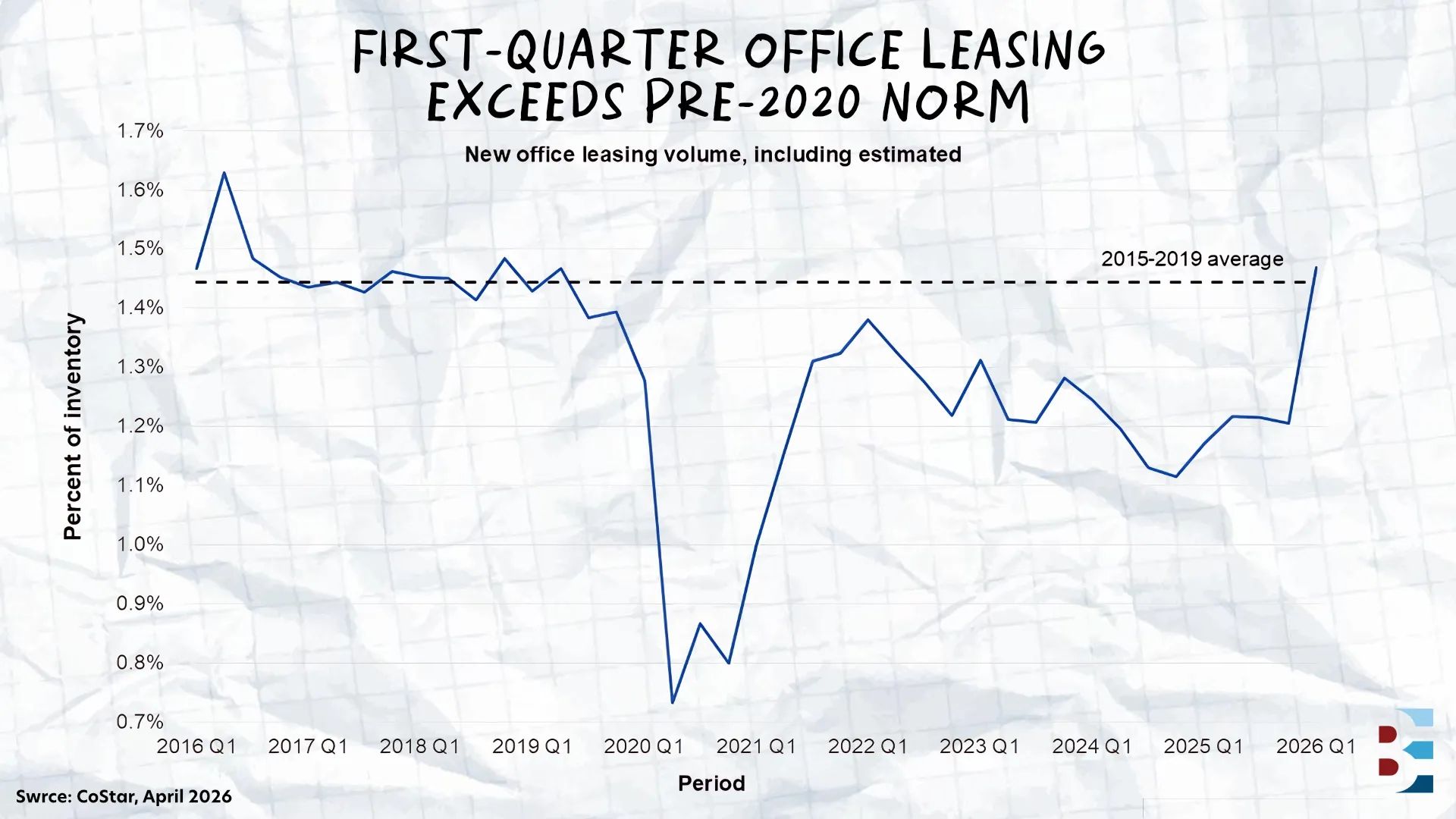
Office tenants signed 120M SF in new leases in Q1 2026 — the highest quarterly total since 2018 and a 25% jump from Q1 2025 — as leasing volume hit a decade high, driven by smaller, shorter-term deals and strong demand from financial institutions returning workers to the office.
🏠 10 Million
The White House Council of Economic Advisers has estimated the U.S. single-family housing deficit at a minimum of 10 million units — well above Freddie Mac's 3.7 million projection and NAR's 5.5 million estimate — as years of underbuilding since 2008 compound an affordability crisis with the 30-year fixed mortgage rate now at 6.37%.
🔑 $4,800
Cherry Development is allowing Las Vegas apartment renters to set aside $200 per month toward a future home down payment, capping at $4,800 over 24 months. The Path to Homeownership program targets historically low turnover while giving residents a structured route to ownership — and keeping vacancy filled in the process.
🦙 BEST EVER WEBINARS
THREE STRATEGIES. ONE DIVERSIFIED INCOME PORTFOLIO.

Most investors are sitting on the wrong side of the trade right now.
While equity investors absorb volatility, private credit lenders are quietly collecting double-digit returns — secured by real assets and paid through consistent distributions.
🗓️ On April 23 at 1pm ET, Chris Lopez and Richard McGirr break down Three Private Debt Strategies Targeting 16.4% to 20.4% Annual Cash Flow and show you exactly how to put this opportunity to work in your portfolio. You'll leave with a clear understanding of what each strategy pays, how it's structured, and whether it belongs in your allocation.
Free to attend. Register now 👇
🎙️ THE BEST EVER CRE SHOW
IS THE AIRBNB MODEL COMING FOR CRE?

Most commercial property owners are sitting on extra revenue and don’t even know it. A spare desk, an unused medical exam room, a half-empty warehouse shelf — fractional space has always existed inside CRE portfolios. What hasn't existed, until recently, is an easy way to monetize it.
This week, on the Best Ever CRE Show, Steve Taylor joined Amanda Cruise to discuss how he built SoCommercial, a listing platform designed to help owners lease fractional commercial space — everything from single desks to partial warehouse bays — without going through a traditional broker.
The opportunity cuts across asset classes:
Office Owners: Operators with vacant suites or excess square footage can list individual desks or partial floors directly, setting their own price, terms, and access conditions without broker involvement or minimum size requirements.
Industrial and Warehouse Operators: Partial bays, individual shelving, and short-term storage space can be listed and priced independently — space that typically sits dark because it falls below the threshold traditional brokers will touch.
Medical and Retail: Owners with spare exam rooms or underutilized retail square footage can specify the type of tenant they want, creating collaboration opportunities alongside the income stream.
The underlying logic mirrors what Airbnb did for residential — aggregating space that was always there but had no efficient route to market. Taylor's framing: "We just build the freeway, and cars can ride across it."
🙏 Thanks for reading!
Stay in the loop with us! If you received this newsletter from someone else, subscribe here. You can also find us on LinkedIn, Instagram, and YouTube.
Have a Best Ever day!
— Joe Fairless